At Deer Valley Resort, summer 2025 was marked by an ambitious expansion as crews installed a whopping seven new lifts. Chinook helicopters flew in pylons, and all eyes looked to what the doubling of terrain could reap.
One downside of such rapid growth, however, was that the upper bike park laid dormant for safety reasons. Park City’s 400-plus miles of cross-country and enduro trails stayed open, as did the lower-mountain chairlifts, but it felt something like a lost season.
But not this year. “2026 has really been about how mountain biking is back,” says Doug Gormley, Deer Valley’s lead mountain bike coach.
In addition to buffing and rehabbing the existing trails, the crew worked hard to build the downhill race course for the Fox US Open of Mountain Biking from September 11 to 13, when some of the world’s most talented riders hucked themselves off rocks and dirt in pursuit of glory. As the final stop of the U.S. racing series, the Open also marked Deer Valley’s return to its roots as a downhill venue, after more than 15 years away from national-level racing — with the steepest, most technical course in years.
Then, on cue, the legendary Aaron Gwin took gold, 18 years after his rookie season, when he first raced here in 2008. According to Gormley, Deer Valley is one of the oldest lift-served parks in the country with a long history. It used to host National Off-Road Bicycle Association events back when that series would attract World Cup riders.
If you’re not a mountain biker, the sport can look intimidating, especially if you’ve ever watched pro competitions. Like all alpine pursuits, it’s not without danger. But Gormley believes mountain biking is misnamed. “It should be called trail riding,” he says. “We don’t want to shut things off to people; we want to open things up.”
As with skiing, there’s a wide range of difficulty and risk. Gravity Logic, which constructed Whistler’s bike park, built four of Deer Valley’s flow trails, each designed to be progressive. You can start on the green Holy Roller, then move up to the intermediate Tidal Wave or Undertow before graduating to Tsunami, a black diamond jump trail. Gormley explains that a key advantage of riding the park is the volume of riding and descending. In other words, the lift is an amazing tool for repetition; it’s easy to track your improvement after a few laps. “The recipe is the right equipment, the right trails and the coaching component,” he says. “With that, mountain biking can be for everyone.”
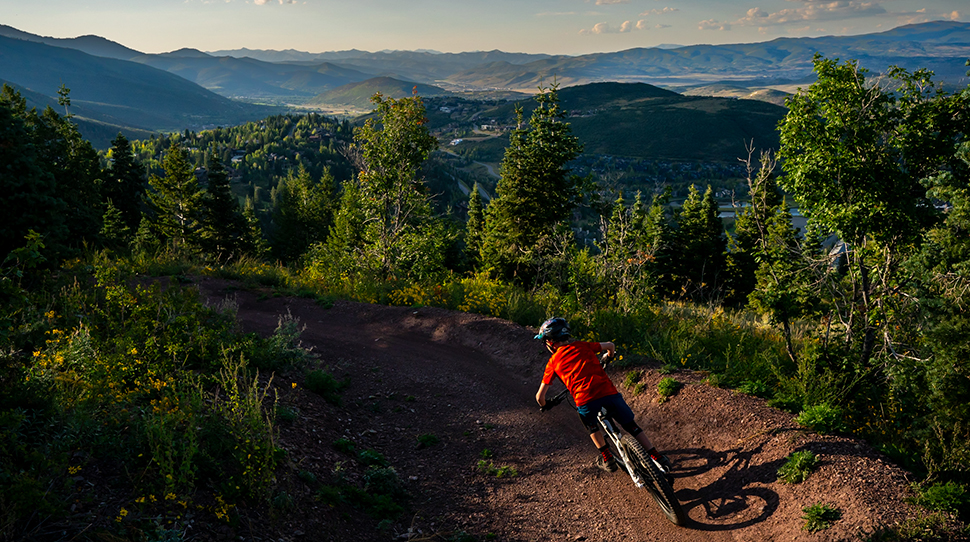
A typical riding day at Deer Valley begins when you collect your bike from the rental shop and meet your instructor or guide. After a quick bike fitting and inspection, you’ll head to the chairlift. From Silver Lake Village, this means taking Sterling Express to the top of Bald Mountain. Then your guide will likely have you pedal to Holy Roller, where you’ll corner into one of Deer Valley’s most spectacular views, a panorama encompassing the upper reaches of the Eastern Expansion and the peaks of the Wasatch Range. It’s an instant affirmation of why mountain action sports are so exhilarating. Like its winter cousins, mountain biking combines the rush of adrenaline, the Zen of present focus and immersion in nature, like forest bathing at speed.
Deer Valley’s bike park offers 60 miles of trails, with features spanning easy, long-and-low jumps to steep-lipped tabletops and the mandatory drops and gaps of the expert runs. But the park also taps into one of the most extensive mountain bike networks in the world. “We sort of plopped a downhill park in the middle of a lot of cross-country trails,” Gormley says. Because of this, riders can “earn their turns” by pedaling up and entering the runs without taking the chairlift. This summer, the resort began offering a $50 season pass for people who ride this way, encouraging uphill access while raising funds for trail maintenance — similar to the uphill travel passes available at some winter resorts.
On the flip side, you can also use the lift to ride out of the park on one of the routes linking to different peaks and wilder areas. Gormley likens this to side-country skiing. “We’re so lucky in Utah with such a diversity of trails,” he says. “It’s really special. And e-mountain bikes have extended people’s access.” Here, he’s referring to Class 1 e-bikes, which max out at 20 mph and have no throttle. These aren’t the moped-like machines you might see zipping around your neighborhood. You still have to pedal, but the motor kicks in to make it easier.
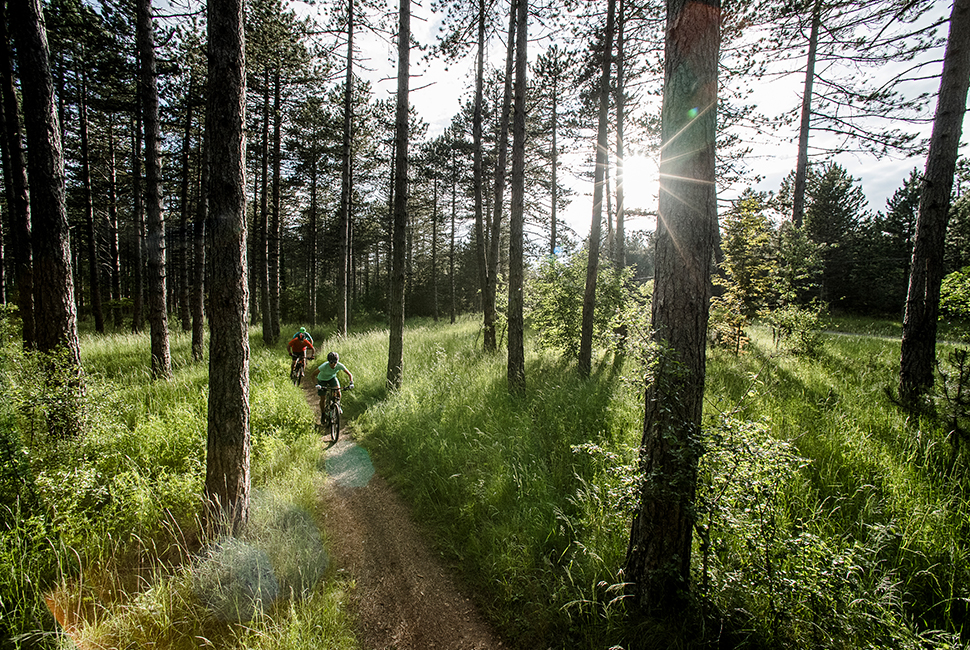
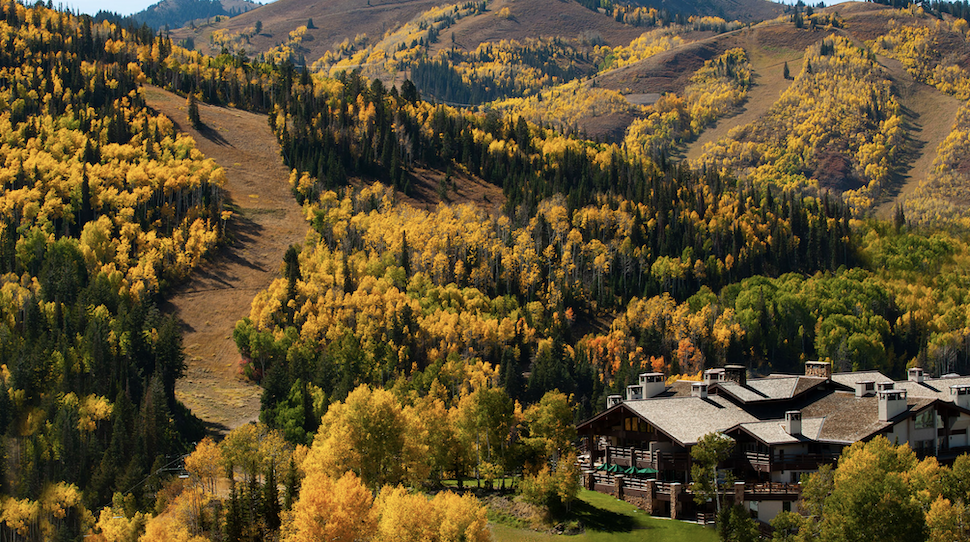
On an e-mountain bike ride, you might traverse from the top of Bald Mountain across high alpine meadows, through aspen glades and pine forest and over to the Empire area. Along the way, your guide may point out a few “skidders,” the gnarly off-map runs built straight down fall lines. Or you might stop at the cliffs beneath the Lady Morgan chair, near Deer Valley’s western boundary. Regardless, it will feel like an adventure as you explore new terrain. An epic ride will expose you to wildflowers, beautiful-but-poisonous red baneberries, vistas of rocky chutes you won’t believe people ski in winter and the paved ribbon of Guardsman Pass winding into Big Cottonwood Canyon. You’re sure to hear birds, and if you’re lucky, you may spot mule deer, elk or moose.
Even with the assistance of an electric motor, mountain biking is physically demanding, especially if you’re coming from sea level. Fortunately, Park City offers much more than on-mountain sports. For a recovery ride, hit the Union Pacific Rail Trail, with 28 miles of pavement and gravel through town, pastures and along a river with beaver ponds. Fly fishing on the blue-ribbon Provo River is another way to enjoy the scenery. And even if you can’t snag a brown trout or whitefish, and the cold water feels nice on tired legs.
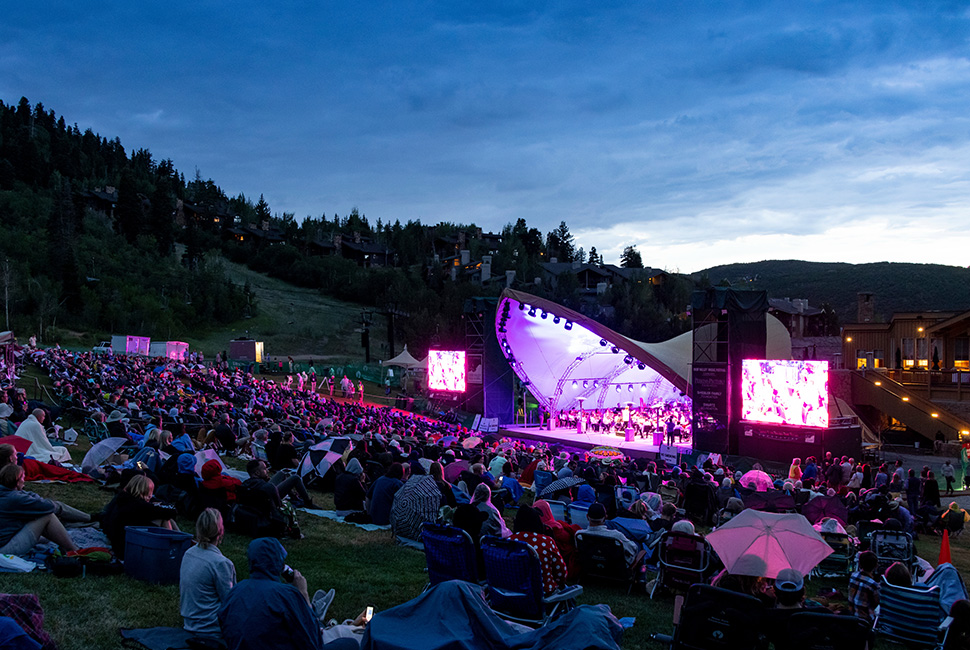
Or check out some live music in the evening. The Utah Symphony | Utah Opera runs the annual Deer Valley Music Festival, a six-week concert series featuring performers like Lyle Lovett and Idina Menzel. In July, music director-designate Markus Poschner conducted his debut concert here with Beethoven’s Symphony No. 9. It’s a community scene, where you can choose between reserved seating and spreading out on the lawn. The Song Summit festival, which spotlighted acts like Sierra Hull and Jim James of My Morning Jacket this past August, also creates a vibe throughout town.

The quality of food and accommodation here far exceeds that of most mountain biking destinations, as well. Fuel up on French cuisine at Le Depot Brasserie or farm-to-table fare at Tupelo Park City (try the stream-raised Idaho trout and don’t skip the biscuits). If you can get reservations, make sure to sample High West Distillery’s whiskey pairings at Nelson Cottage, too.
Ride-in/ride-out hotels are abundant, especially if you’ve rented an e-bike. Just a short stairway from Sterling Express, Forbes Travel Guide Five-Star Stein Eriksen Lodge provides the most direct bike park access. Five-Star Montage Deer Valley occupies a prime location in the Empire area. Both resorts have in-house outfitters that rent bikes, and their spas (Five-Star and Four-Star, respectively) offer massage and hydrotherapy, the perfect prescription for post-ride recovery.
