For years, economy class has been a losing proposition for travelers. While airlines squeezed in more seats and reduced legroom, premium cabins got all the investment, with new business suites and lavish first-class enclaves.
However, with more nonstop, ultra-long-haul routes connecting the farthest corners of the globe, some carriers are getting innovative in economy as well. Air New Zealand executives say their solution to travelers being in a tube for nearly a full day involves beds in economy.
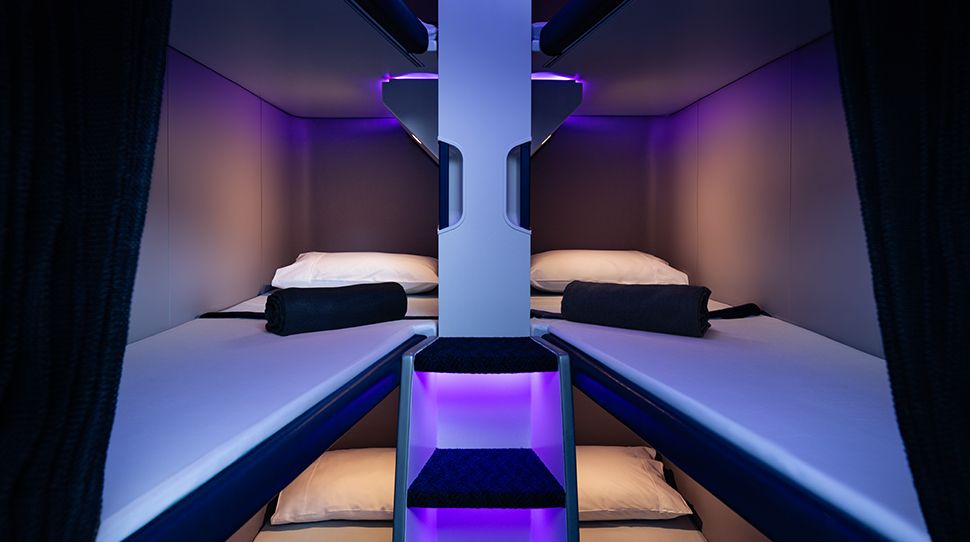
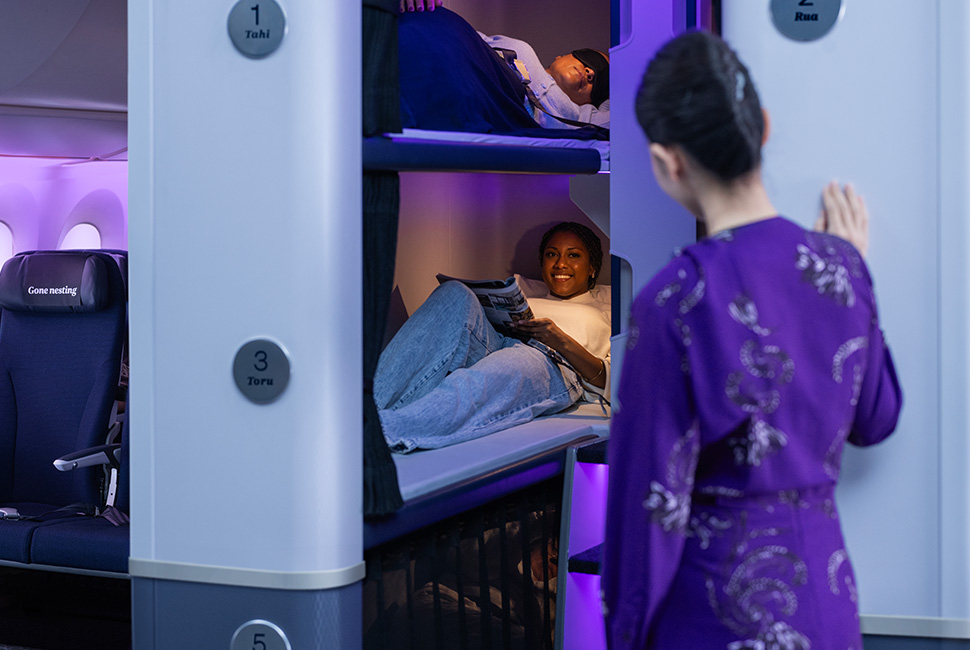
Starting in November, the carrier will debut a concept called Skynest on flights between New York and Auckland, one of the longest routes in commercial aviation at nearly 18 hours. The product is a cluster of six lie-flat sleep pods arranged in three tiers — the setup is essentially bunk beds in the sky — between the economy and premium economy cabins on its newest Boeing 787-9 aircraft. Each pod can be reserved for a four-hour session.
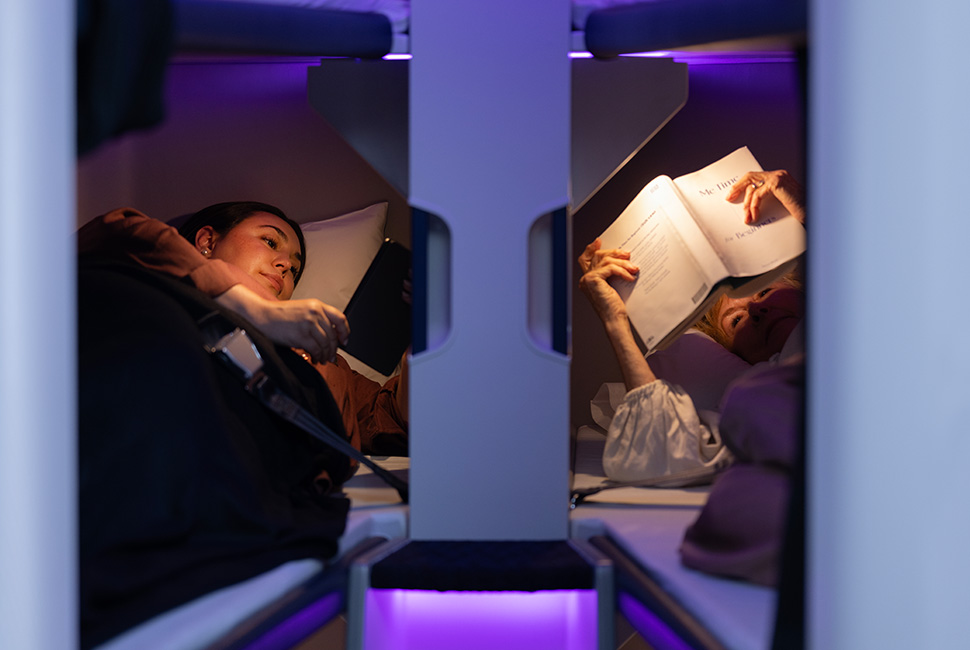
A nest measures roughly 6.5 feet long and 25 inches wide at the shoulder, with a full pillow, crisp sheets, a blanket, a mesh privacy curtain and an amenity kit that includes an eye mask, earplugs and hand cream from New Zealand brand Aotea.
“Each pod has its own ventilation unit, USB and USB-C charging, and its own reading light,” says Jeremy O’Brien, Air New Zealand’s chief customer officer. “We’ve tried to make it genuinely a nest and a private space to be in.”
In fact, O’Brien notes that the design cues came from outside aviation. That includes sleeper carriages on long-distance trains, with additional nods to Japanese capsule hotels.
The four-hour window is engineered around sleep science. “Four hours is 2.8 sleep cycles,” O’Brien says. “You get maybe 15 to 20 minutes to settle into your sleep and 15 to 20 minutes with ambient lighting coming up to wake you. The goal is to get two full REM cycles that actually break the journey.”
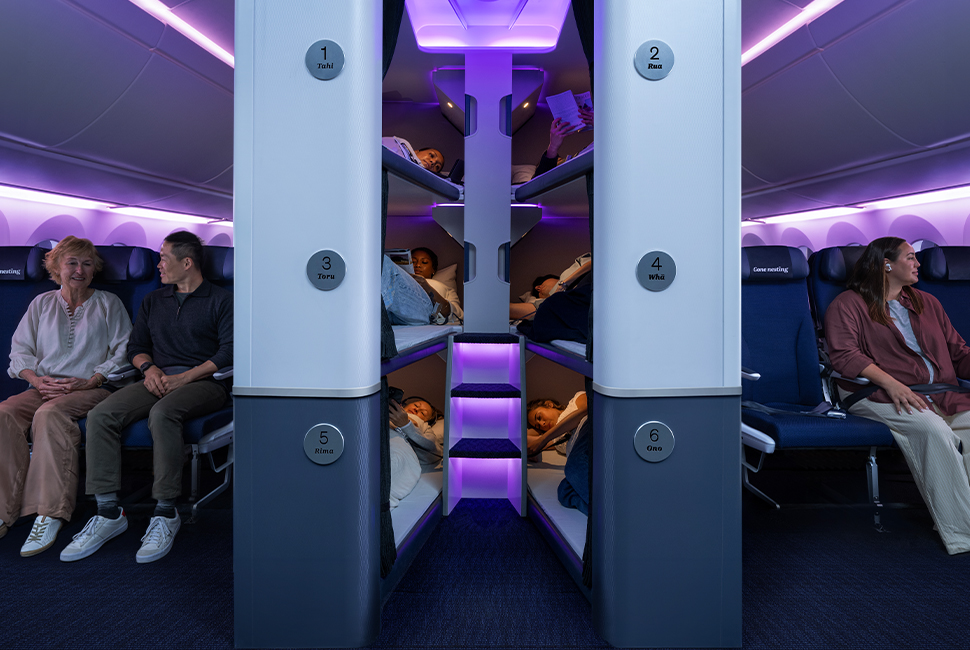
Skynest will be bookable as an add-on to an economy or premium economy fare. Two sessions will be offered per flight at launch, timed around the window between meal services, with a maximum of one session per passenger. Bookings open May 18 for travel starting in November.
According to O’Brien, the airline views this as a live experiment. “We will launch and learn,” he says. “We think people will have a preference for bottom, middle or top bunk. We think maybe the first session versus the second session might be more popular, or vice versa. Over time, we’ll use normal supply and demand to set the model, but we really don’t know until we put it into the market.”
Skynest is the second lie-flat product Air New Zealand has brought to the economy cabin. The first was Skycouch, introduced back in 2011, which converts a row of three economy seats into a flat couch that can be booked solo or shared with a partner or child. Skycouch (which won Innovation of the Year in Forbes Travel Guide’s 2025 Verified Air Travel Awards) is the more practical option for families or anyone who wants flat space for the entire flight. Skynest is also restricted to passengers 15 and older, while Skycouch has no age limit.
Another airline closer to home also sees the value of beds in economy. United Airlines unveiled the Relax Row earlier this year, a dedicated row of three economy seats with adjustable leg rests that fold up to create a flat surface. (It’s also paired with a fitted mattress pad and extra pillows.) Effectively, it’s a stateside take on Skycouch, since Air New Zealand licensed the patent to United. Relax Row rolls out across more than 200 Boeing 787 and 777 widebodies starting in 2027.
“The Kiwi culture is just to innovate and try,” O’Brien says. “Historically, because we’ve been isolated, we’ve had to solve our own problems.”
For travelers who have spent years improvising with empty rows and contorted neck pillows, four hours of actual flat sleep on an 18-hour flight might be what finally gets them on the plane.
“We think New Zealand’s got a great proposition,” O’Brien says. “But the journey is one of the barriers to considering it. We’ve gone as an airline that wants to service that market and decided we have to be the best on sleep.”
